Teaching Portfolio
Grading Rubric Examples
Overview
This document provides a few graded examples of two basic types of written material from my courses: essay questions and activity worksheets. You are encouraged to first read the full explanation of my grading guidelines.
Graded 4-Point Essays
Essay with an Unacceptable Answer
What is a standardized score and how is it interpreted? Answer the question by defining a standardized score and by describing the major properties or features of a standardized score.
A standardized score is an average or most common/likely score. Though it is not always the most frequently occurring score, it can be used to represent what most peoples scores were. The standardized score is usually a score found near the center of a frequency distribution. Standardized scores while useful, are somewhat irrelevant without additional information such as the standard deviation.
| Category | Unacceptable | Problematic | Satisfactory | Commendable |
|---|---|---|---|---|
| Theories & Concepts (0-3 Points) | ☑ Inappropriate ☑ Incorrect ☑ Incomplete |
☐ Vague Relevance ☐ Major Inaccuracies ☐ Insufficient Detail |
☐ Implied Relevance ☐ Minor Inaccuracies ☐ Broad Detail |
☐ Explicit Relevance ☐ No Inaccuracies ☐ Thorough Detail |
| Category | Unacceptable | Acceptable |
|---|---|---|
| Grammar & Organization (0-1 Point) | ☐ Inadequate Format ☐ Major Errors ☐ Poor Consistency |
☑ Adequate Format ☑ Few or No Errors ☑ Adequate Consistency |
Essay grade: 1/4 Points
- This answer is wrong. The student confused a z-score (standardized score) with a measure of central tendency (perhaps the median).
- The answer is probably also too short. While the writing is a bit informal and there are a few errors, it meets expectations.
Essay with a Problematic Answer
What is the most prominent concept in the study of social interaction (conflict, aggression, prejudice, and prosocial behavior)? Describe the important terms and principles of a theory that incorporates this concept.
I believe that helping theory is the most important concept. I would like to believe that humanity is naturally good but this theory shows that the presence of possible benefits and of other people actually determine how we react. It is this theory of helping where people go through stages on the way to help others. In the end, you provide help. I never thought people could be so callous, but with cases like the Kitty Genowveve case it shows that the knowledge of these steps may improve the chances to help.
| Category | Unacceptable | Problematic | Satisfactory | Commendable |
|---|---|---|---|---|
| Theories & Concepts (0-3 Points) | ☐ Inappropriate ☐ Incorrect ☐ Incomplete |
☐ Vague Relevance ☑ Major Inaccuracies ☑ Insufficient Detail |
☐ Implied Relevance ☐ Minor Inaccuracies ☐ Broad Detail |
☐ Explicit Relevance ☐ No Inaccuracies ☐ Thorough Detail |
| Category | Unacceptable | Acceptable |
|---|---|---|
| Grammar & Organization (0-1 Point) | ☐ Inadequate Format ☐ Major Errors ☐ Poor Consistency |
☑ Adequate Format ☑ Few or No Errors ☑ Adequate Consistency |
Essay Grade: 2/4 Points
- The answer does indeed describe an important theoretical perspective on helping, but it is not as detailed as it could be. Whose theory is being describe and why was it chosen here?
- The answer is too informal and there are a few errors, but it is direct enough to (barely) meet expectations.
Essay with a Satisfactory Answer
What are the main differences between a within-subjects and a between-subjects design? Describe characteristics such as the number of distinct groups, the number of treatment conditions, and the assignment of participants to conditions.
There are several important differences between within-subjects and between-subjects designs. A between-subjects design randomly assigns participants to two or more groups, with one group typically being a control group. A within-subjects design uses the same participants across two or more conditions (and is sometimes called a repeated-measures design).
| Category | Unacceptable | Problematic | Satisfactory | Commendable |
|---|---|---|---|---|
| Theories & Concepts (0-3 Points) | ☐ Inappropriate ☐ Incorrect ☐ Incomplete |
☐ Vague Relevance ☐ Major Inaccuracies ☐ Insufficient Detail |
☐ Implied Relevance ☑ Minor Inaccuracies ☑ Broad Detail |
☐ Explicit Relevance ☐ No Inaccuracies ☐ Thorough Detail |
| Category | Unacceptable | Acceptable |
|---|---|---|
| Grammar & Organization (0-1 Point) | ☐ Inadequate Format ☐ Major Errors ☐ Poor Consistency |
☑ Adequate Format ☑ Few or No Errors ☑ Adequate Consistency |
Essay Grade: 3/4 Points
- Aspects of this answer are acceptable; for example, the description of within-subjects designs is OK. However, not all between-subjects designs involve random assignment. Neglect of these other possibilities means that the answer is too broad.
- As a result, the answer is definitely too short. Nonetheless, the writing style is generally good.
Essay with a Commendable Answer
The field of social psychology endured significant critique during the 1960s and 1970s. What were the most important elements of this critique and how has this altered the study of human social behavior?
During the 60s and 70s, social psychology was criticized for two primary reasons: 1 – it did not take history and culture into account and 2 – its use of research methods suffered from ethical problems.
The textbook notes that many of the studies conducted in social psychology through the 70s were primarily on American-college students (just like the studies I had to participate in for my Intro Psych credit last year!). The field increased the number of cross-cultural studies during the 90s (they mention a study by Markus on the self). This has led to an improvement of the field.
The second challenge (unethical studies) resulted largely from Milgram’s famous “shock” study of obedience. This study caused debate because some believed that it was unethical – how can you ethically shock people and not let them leave the experiment? There are many everyday topics we want to know more about (such as aggression and romantic relationships), but the field needs to find ethical ways of studying these topics. Following the Milgram study, the field increased the number of ethical standards research needs to follow.
Each of these challenges to the field is important because they represent a more “pluralistic” approach to research, where many different methods are used. They show that the history of social psychology research has a very real application to everyday life.
| Category | Unacceptable | Problematic | Satisfactory | Commendable |
|---|---|---|---|---|
| Theories & Concepts (0-3 Points) | ☐ Inappropriate ☐ Incorrect ☐ Incomplete |
☐ Vague Relevance ☐ Major Inaccuracies ☐ Insufficient Detail |
☐ Implied Relevance ☐ Minor Inaccuracies ☐ Broad Detail |
☑ Explicit Relevance ☑ No Inaccuracies ☑ Thorough Detail |
| Category | Unacceptable | Acceptable |
|---|---|---|
| Grammar & Organization (0-1 Point) | ☐ Inadequate Format ☐ Major Errors ☐ Poor Consistency |
☑ Adequate Format ☑ Few or No Errors ☑ Adequate Consistency |
Essay Grade: 4/4 Points
- The student uses terms from the literature (jargon such as “pluralistic”) and they are defined. The two primary criticisms are described in sufficient detail, including several quality examples throughout.
- The answer is quite focused, organizing the various points in clear paragraphs. With few errors in structure or grammar, it easily meets expectations.
Graded 4-Point Activities
Activity with a Problematic Answer
Identify factors that you believe influence bystander intervention. For each type, please provide: 1) a clear name or label for that factor, 2) the important principle or logic behind that factor, and 3) at least one example that fits that factor.
(As an activity, submission of a worksheet with a table is expected.)
| Factor Influencing Helping | Explanation | Everyday Example |
|---|---|---|
| Observation of a helpful model | When someone helps another person, we should be doing the same thing. Assume responsibility. | At the grocery store, helping an elderly person load their care. Or holding the door open for someone. |
| Not in a hurry | When people are not in a rush, they’re more willing to intentionally intervene to help. | Loading groceries, helping someone (neighbor) rake their yard, get their mail. |
| Few other bystanders | The person may not feel judged if they choose to help someone that others may be intimidated by. | Helping someone who is handicapped complete a task they may not be able to do on their own. Giving up a seat on a bus. |
| Category | Unacceptable | Problematic | Satisfactory | Commendable |
|---|---|---|---|---|
| Applications & Evidence (0-3 Points) | ☐ Inappropriate ☐ Incorrect ☐ Incomplete |
☐ Vague Relevance ☐ Major Inaccuracies ☐ Insufficient Detail |
☑ Implied Relevance ☐ Minor Inaccuracies ☑ Broad Detail |
☐ Explicit Relevance ☐ No Inaccuracies ☐ Thorough Detail |
| Category | Unacceptable | Acceptable |
|---|---|---|
| Grammar & Organization (0-1 Point) | ☐ Inadequate Format ☐ Major Errors ☑ Poor Consistency |
☐ Adequate Format ☐ Few or No Errors ☐ Adequate Consistency |
Activity Grade: 2/4 Points
- The labels for the factors are a bit vague, but the brief explanations do help to clarify what the student is thinking. However, the examples are not always clearly and explicitly an application of the factor that has been described.
- Note that writing style includes several sentence fragments that deprive the example from being clear.
Activity with a Satisfactory Answer
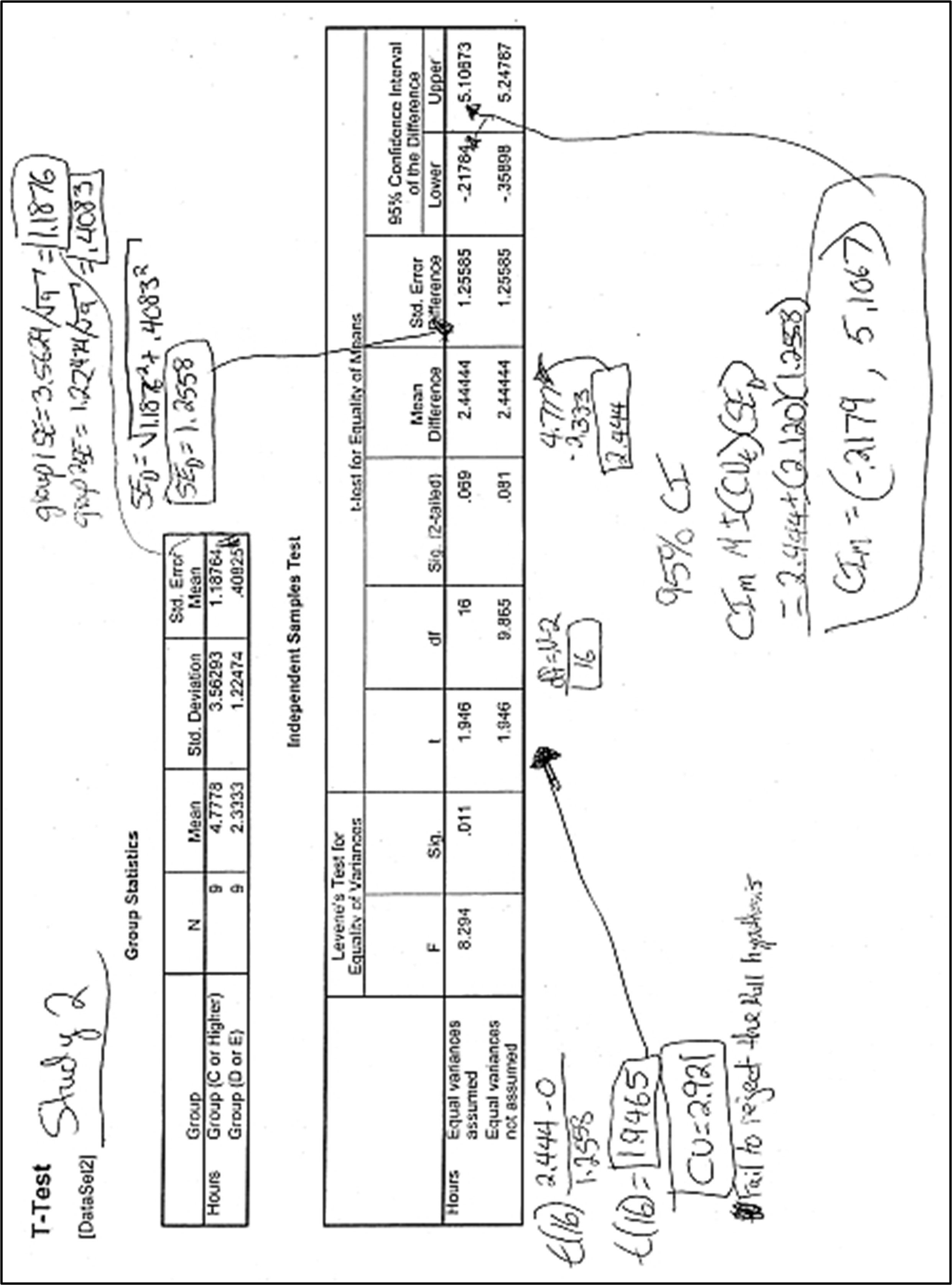
Study 1 (Nonexperimental): An instructor hypothesized that the students who earn a B or higher spend a significantly different number of hours per week outside of class on course work than those who receive a C or lower. She collects the following data on two independent samples of students.
B or higher: 9, 4, 7, 11, 1, 5, 3, 2, 1
C or lower: 3, 2, 0, 3, 2, 1, 4, 3, 3
-
Given the data for the study above, use SPSS to obtain an independent samples t test and a confidence interval for the difference between the means (using α = .01).
a. On your SPSS output, calculate “by hand” the statistical significance test and the confidence interval using the descriptive statistic information given to you. [You do not need to recalculate the means and standard deviations.] Use appropriate marks (e.g., arrows, circles, etc.) to show that your calculations match the statistics provided by SPSS. (3 pts.)
b. Describe your findings in an appropriate APA-style Results section. Be sure to follow the standards given in class. (1 pt.)
| Category | Unacceptable | Problematic | Satisfactory | Commendable |
|---|---|---|---|---|
| Procedure & Solution (0-3 Points) | ☐ Inappropriate ☐ Incorrect ☐ Incomplete |
☐ Vague Relevance ☐ Major Inaccuracies ☐ Insufficient Detail |
☐ Implied Relevance ☐ Minor Inaccuracies ☐ Broad Detail |
☑ Explicit Relevance ☑ No Inaccuracies ☑ Thorough Detail |
| Category | Unacceptable | Acceptable |
|---|---|---|
| Grammar & Organization (0-1 Point) | ☑ Inadequate Format ☐ Major Errors ☐ Poor Consistency |
☐ Adequate Format ☐ Few or No Errors ☐ Adequate Consistency |
Activity Grade: 3/4 Points
- This student did a very good job with the calculation part of the problem (Part a). The SPSS is printout is correct. The hand calculations are on the printout and they match the SPSS printout. The student clearly indicated that she understood how the calculations match the output by using arrows and boxes.
- However, the second part of the problem (Part b) is virtually missing. There is a slight interpretation of the output (“fail to reject the null hypothesis”), but there is no written description or explanation of the results in appropriate APA style.
Activity with a Commendable Answer
Choose a recent media claim about human behavior. Adopt a skeptical, scientific approach to the problem by beginning to design an empirical study that could be used to test the claim.
List the Media Claim That You Will be Testing: “Skeptics are less gullible but more lonely”
How would you define and describe the important principles or practices of your study?
First, we need to find two groups of people – skeptics and “acceptors.” We need will differentiate them using a pretest survey (to be built later).
Next, we’d need to measure both gullibility and loneliness. The claim would only be accurate if we found group differences on both of these measures. Lonliness might be easier to measure (again a survey) but gullibility is harder. Perhaps people could read an urban legend and state whether they believe it!
How would you assure that your study ruled out alternative explanations for the behavior?
This would be more difficult. The research would be nonexperimental because the researchers would not determine who is the skeptic and who is not. Therefore, it would be hard to determine cause and effect.
On second thought, that shouldn’t matter for the claim. The claim does not try to describe WHY the difference exists, only that it does exist. We will consider alternative explanations for the differences later.
What things might you need to be careful about while running the study?
The claim is not clear what the people are skeptical about. Some people might be skeptical about the politics of health care, but not at all about religion. So, we would need to be very careful about how we measure things (as stated above) but also about what conclusions we make (cause and effect).
| Category | Unacceptable | Problematic | Satisfactory | Commendable |
|---|---|---|---|---|
| Applications & Evidence (0-3 Points) | ☐ Inappropriate ☐ Incorrect ☐ Incomplete |
☐ Vague Relevance ☐ Major Inaccuracies ☐ Insufficient Detail |
☐ Implied Relevance ☐ Minor Inaccuracies ☐ Broad Detail |
☑ Explicit Relevance ☑ No Inaccuracies ☑ Thorough Detail |
| Category | Unacceptable | Acceptable |
|---|---|---|
| Grammar & Organization (0-1 Point) | ☐ Inadequate Format ☐ Major Errors ☐ Poor Consistency |
☑ Adequate Format ☑ Few or No Errors ☑ Adequate Consistency |
Activity Grade: 4/4 Points
- For an in-class activity with limited space, the answers are fairly thoughtful. Major aspects of measurement and research design are addressed, as are concerns about generalization. Of course, many more details would be required for a full research proposal on the topic.
- Note that writing style (grammar, spelling, etc.) is evaluated here. There are typographical and grammatical errors, but they are quite minor. Therefore, there is no deduction.